Bipolar TURP (Transurethral Resection of the Prostate)

Medical Review & Verification: Dr. Niti Navanimitkul, M.D.
Board-Certified Urological Surgeon | Specialist in Endourology & Prostate Diseases | M-Trust Urology Clinic
Last Reviewed: July 2026The gold standard surgical treatment for Benign Prostatic Hyperplasia (BPH) using advanced bipolar energy and saline irrigation to maximize safety and eliminate TUR syndrome risk.
What is Bipolar TURP?
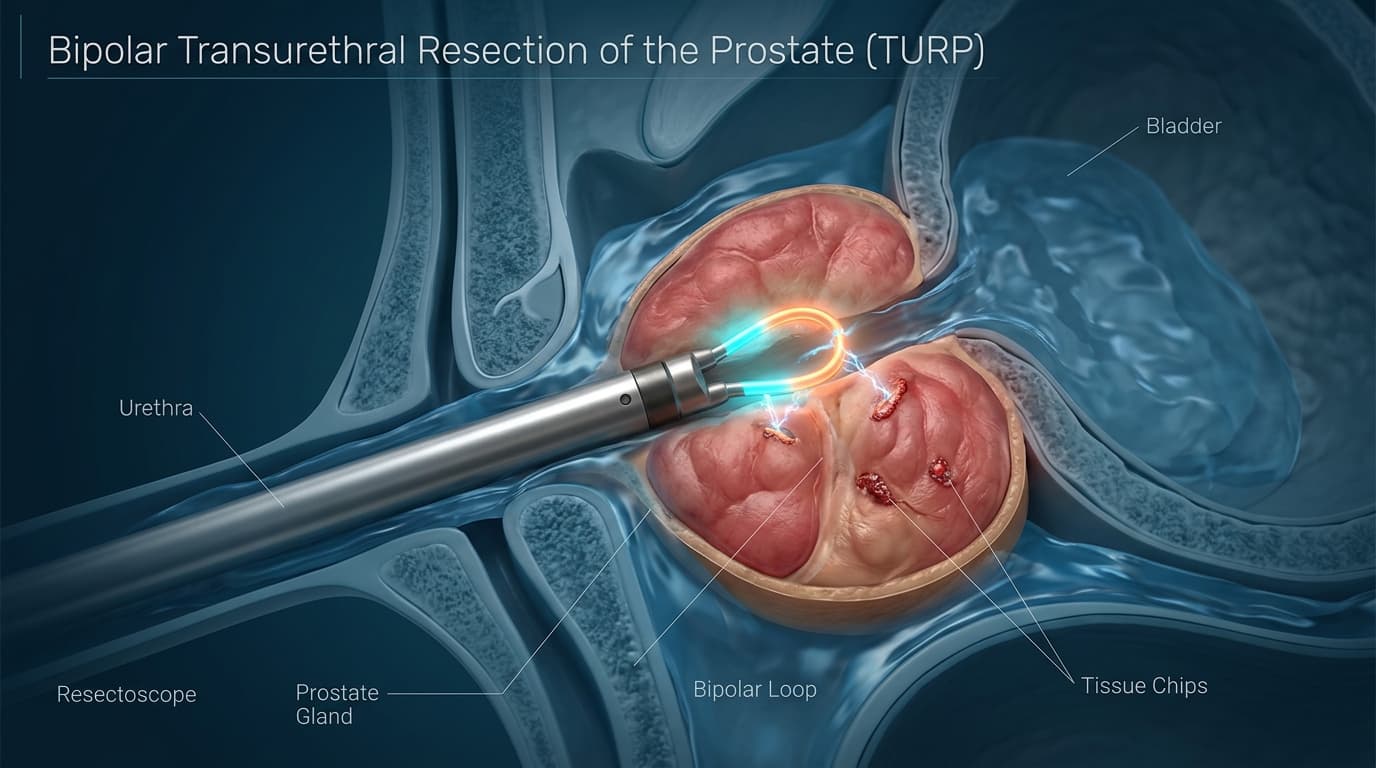
Bipolar TURP (Transurethral Resection of the Prostate) is an advanced endoscopic surgery performed to treat moderate-to-severe urinary symptoms caused by an enlarged prostate (BPH). Using a specialized bipolar loop electrode, the surgeon resects obstructing prostate tissue layer by layer through the urethra, opening up the urinary passage [1]. This technique represents a major safety evolution from traditional Monopolar TURP [2].
The critical safety improvement of Bipolar TURP lies in its use of normal saline (0.9% NaCl) as the irrigation fluid instead of sterile water or non-conductive fluids (such as Glycine or Sorbitol) used in monopolar surgery. This transition eliminates the risk of Transurethral Resection (TUR) Syndrome—a rare but life-threatening complication characterized by severe hyponatremia (low blood sodium) and fluid overload [3].
The Bipolar Safety Profile
With bipolar energy, the electrical current is confined entirely between the active and return electrodes on the resection loop tip itself, rather than passing through the patient's body to a grounding pad on the thigh. This localized electrical flow prevents thermal damage to surrounding tissue and protective pelvic nerves that control erections. Bipolar vaporization also yields far superior sealing of bleeding vessels, reducing blood loss and lowering transfusion rates [4].
How Bipolar TURP Works
The procedure is completely internal, leaving no external surgical scars on the patient's body [5]:
1. Anesthesia Administration
The patient is given spinal anesthesia (numbing from the waist down) to ensure complete comfort and pain relief throughout the procedure.
2. Endoscopic Resection
A thin resectoscope is inserted through the urethra. The surgeon utilizes the high-frequency bipolar loop to trim obstructing prostate lobes into small fragments under continuous saline irrigation.
3. Hemostasis and Retrieval
As tissue is cut, the bipolar energy simultaneously cauterizes open blood vessels. The tissue fragments are then irrigated out of the bladder and sent to a pathology lab for diagnostic analysis.
Pre-operative Diagnostic Assessments
To ensure that Bipolar TURP is the safest and most effective option, urologists conduct a comprehensive clinical workup [6]:
1. IPSS Symptom Evaluation
Assessing the severity of urinary symptoms (hesitancy, weak flow, nocturia) to establish a clinical baseline.
2. Prostate Volume Measurement
Transrectal ultrasound (TRUS) or pelvic MRI is performed to determine exact prostate size and assess lobes conformation.
3. Uroflowmetry & Residual Urine
Measuring the urinary flow rate and post-void residual (PVR) volume to quantify the degree of bladder outlet obstruction.
4. PSA Screening Test
Performing a Prostate-Specific Antigen blood test to screen for prostate cancer before any surgical tissue resection is planned.
Bipolar TURP vs. Alternative BPH Treatments
An academic overview of clinical differences between surgical options for benign prostatic enlargement [7]:
Clinical Advantages and Limitations of Bipolar TURP
⊕ ข้อดี (Pros)
- ✓Zero risk of water intoxication (TUR Syndrome) due to safe saline irrigation.
- ✓Superior hemostasis with bipolar current reduces intra-operative bleeding and transfusion needs.
- ✓Lower thermal penetration protects pelvic nerves, preserving erectile function.
- ✓Shorter catheterization time and reduced hospital stay compared to monopolar TURP.
- ✓Provides ample tissue specimens for pathological evaluation to exclude malignancy.
⊖ ข้อจำกัด (Cons)
- ✗High rate of retrograde ejaculation (dry orgasms) due to the open bladder neck after resection.
- ✗Requires spinal or general anesthesia and temporary catheterization.
- ✗Less efficient than laser enucleation (HoLEP) for exceptionally large prostates (>100g).
Who is a Candidate for Bipolar TURP?
Bipolar TURP is suitable for patients experiencing significant BPH symptoms who meet these conditions [8]:
- ▹Moderate-to-severe LUTS: Experiencing severe urinary retention, weak stream, or frequent urination that fails to respond to medications.
- ▹Prostate volume between 30g and 80g: This size range is ideal for endoscopic loop resection (larger glands are better candidates for HoLEP).
- ▹Patients with cardiac or metabolic concerns: High-risk patients who require a safer option that prevents electrolyte imbalances during surgery.
- ▹BPH complications present: Patients with recurrent urinary tract infections (UTIs), bladder stones, hematuria, or obstructive renal damage.
Clinical Outcomes & Success Rates
Statistical data compiled from multi-center randomized controlled trials [9]:
Symptom Improvement
The vast majority of patients achieve immediate, long-lasting relief from urinary blockages.
TUR Syndrome Incidence
No recorded cases of hyponatremia due to the protective saline wash mechanism.
Blood Transfusion Rate
Extremely low blood loss during surgery thanks to the bipolar coagulation capability.
Post-operative Surveillance Calendar
Regular follow-ups ensure optimal healing and monitor long-term bladder health [10]:
- •Weeks 1-2: Office visit for catheter removal (if not done in-hospital) and initial trial of voiding check.
- •Month 1: Evaluation of urinary flow rate (Uroflowmetry) and post-void residual (PVR) volume scan to confirm clearance.
- •Months 3 & 6: Re-evaluating the IPSS score to check bladder muscle recovery and check for late complications.
- •Year 1 & Annually: Routine prostate health check, including PSA testing and uroflowmetry.
Recovery Guidelines & Post-operative Care
Adhering to these guidelines ensures proper tissue healing inside the prostatic fossa [11]:
- •Urinary Catheterization: A catheter is kept in place for 2-3 days post-surgery to drain urine and flush out any small blood clots.
- •Hydration Therapy: Drink at least 2 to 3 liters of water daily to dilute urine and flush out remaining debris.
- •Straining Prevention: Eat high-fiber foods and use stool softeners to avoid straining during bowel movements, which can trigger bleeding.
- •Restricted Activities: Avoid heavy lifting, vigorous exercise, bicycling, or sexual activity for 4 to 6 weeks to prevent secondary bleeding.
Related Topics
Academic References & Medical Literature
- Mamoulakis C, et al. 'Bipolar vs Monopolar Transurethral Resection of the Prostate: A Systematic Review and Meta-analysis of Randomized Controlled Trials.' BJU International, 2012; 109(7):1020-1029. doi:10.1111/j.1464-410X.2011.10737.x.
- Coleman JA, et al. 'Management of Lower Urinary Tract Symptoms Attributed to Benign Prostatic Hyperplasia: AUA/SUO Guideline.' Journal of Urology, 2023; 209(6):1096-1104. doi:10.1097/JU.0000000000003437.
- Geavlete B, et al. 'Bipolar Plasma Vaporization vs Monopolar TURP in BPH: A 3-Year Prospective, Randomized Comparison.' Journal of Endourology, 2013; 27(6):759-766. doi:10.1089/end.2012.0526.
- European Association of Urology (EAU). 'Guidelines on Benign Prostatic Obstruction (BPO).' Arnhem, Netherlands: EAU Guidelines Office, 2024.
- Stabile A, et al. 'Medium-term Outcomes of Bipolar Resection vs Laser Enucleation: A Systematic Review.' European Urology Focus, 2022; 8(4):918-927. doi:10.1016/j.euf.2021.08.004.