Fiducial Implants and Rectal Spacers

Medical Review & Verification: Dr. Niti Navanimitkul, M.D.
Board-Certified Urological Surgeon | Specialist in Advanced Prostate Radiotherapy Prep | M-Trust Urology Clinic
Last Reviewed: July 2026Advanced pre-radiotherapy (SBRT/EBRT) preparatory procedures to achieve sub-millimeter targeting accuracy and protect the rectum wall with absorbable SpaceOAR Hydrogel.
What are Fiducials and Rectal Spacers?
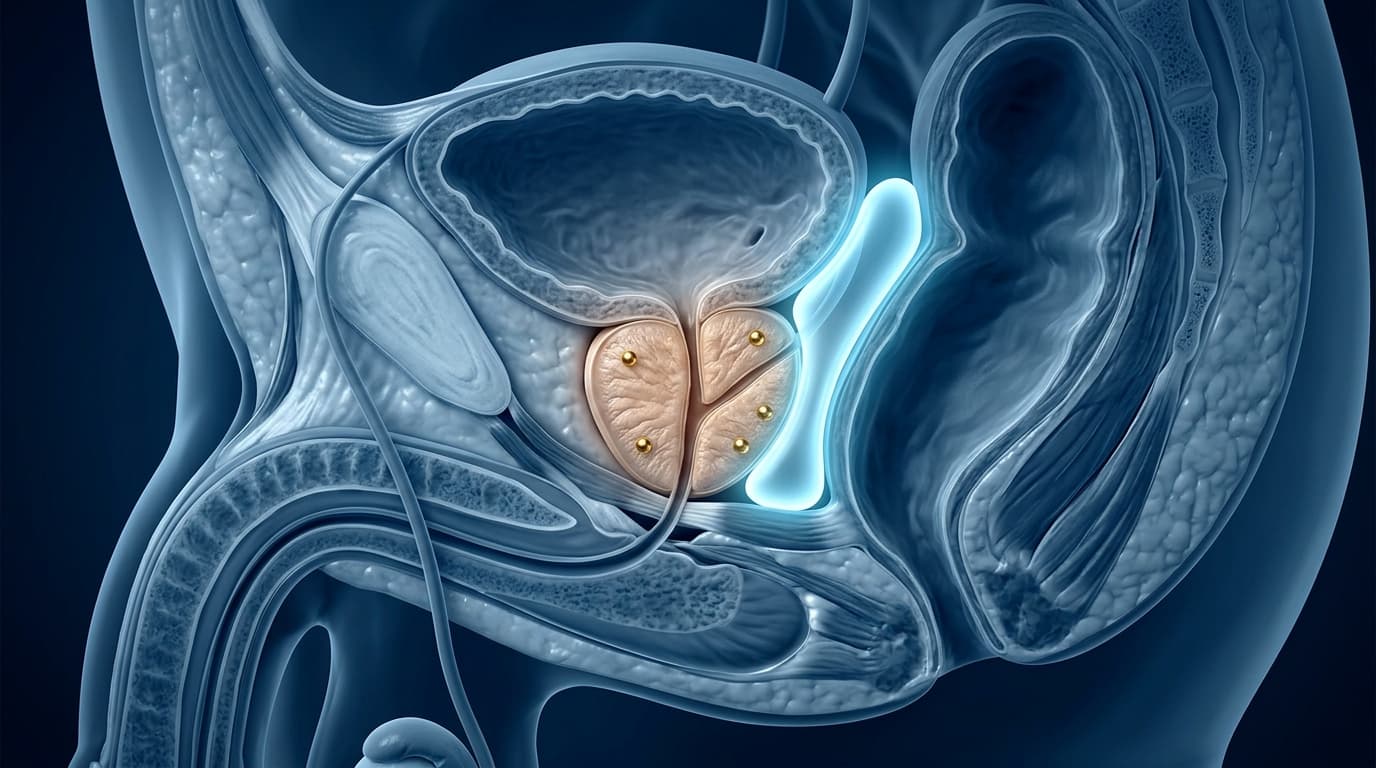
During radiation therapy for prostate cancer (such as SBRT/CyberKnife or standard EBRT), the goal is to target the prostate while avoiding surrounding healthy tissues. Because the rectum lies directly behind the prostate, it is highly susceptible to accidental radiation exposure, which can cause painful radiation proctitis, bleeding, or bowel urgency [1].
To eliminate this risk, two highly effective preparatory procedures are performed prior to radiotherapy: 1. **Fiducial Gold Markers:** Three tiny gold seeds (about 3mm each, the size of a grain of rice) are implanted directly into the prostate. These act as high-contrast internal beacons (like a GPS), allowing the linear accelerator to track the exact position of the prostate in real-time, even as it moves with respiration or digestion. 2. **Absorbable Rectal Spacer (e.g., SpaceOAR Hydrogel):** A temporary liquid gel is injected into the space between the prostate and the rectum. The gel instantly solidifies, creating a 1.3 cm protective cushion that physically pushes the rectum wall out of the high-dose radiation field [2].
How SpaceOAR Hydrogel Works and Dissolves
The rectal spacer (SpaceOAR) is made from Polyethylene Glycol (PEG) hydrogel, a biocompatible material widely used in medical implants. Once injected, the spacer remains stable and keeps the rectum isolated for 3-6 months, covering the entire duration of your radiotherapy. After radiotherapy is complete, the hydrogel naturally liquefies, is absorbed by the body, and is safely cleared in your urine within 6 to 12 months, leaving no foreign material behind [3].
Procedure Steps & Positioning
The quick outpatient procedure takes 20-30 minutes and is performed under local anesthesia, spinal block, or light sedation [4]:
1. Ultrasound Visualization
A transrectal ultrasound probe is used to obtain real-time, high-definition views of the boundary between the prostate and the rectum.
2. Fiducial Gold Marker Insertion
Three gold markers are placed into the prostate gland using a fine needle, establishing permanent 3D target coordinates.
3. Hydrogel Injection
The liquid PEG gel is injected into the space between the prostate and rectum. It instantly expands and solidifies into a soft gel spacer within 10 seconds.
Simulation & Radiotherapy Planning
Following the procedure, your radiation oncology team will maps your custom radiation field [5]:
1. Simulation Scan (CT/MRI)
A planning scan is performed 3-7 days later to capture the new anatomy, visualizing the gold fiducial targets and the protective rectal space.
2. Precise Dosimetry Calculation
Medical physicists design the radiation beams to focus fully on the prostate while completely shielding the rectum, which has been pushed safely out of range.
Radiotherapy with Spacer & Fiducials vs. Conventional Radiotherapy
Comparing clinical outcomes with and without supportive preparatory procedures [6]:
Clinical Advantages and Limitations
⊕ ข้อดี (Pros)
- ✓Reduces rectal radiation exposure by up to 73%, effectively preventing chronic radiation proctitis.
- ✓Improves target precision, allowing clinicians to deliver higher, more curative doses to the tumor.
- ✓Reduces the risk of post-radiation erectile dysfunction by shielding local neurovascular bundles.
- ✓Biocompatible hydrogel is completely absorbed and excreted naturally.
- ✓Performed as a rapid, outpatient procedure allowing same-day discharge.
⊖ ข้อจำกัด (Cons)
- ✗Adds procedural costs for the SpaceOAR kit and gold markers.
- ✗May cause temporary pressure or mild fullness in the rectum for the first 24-48 hours.
- ✗Requires a minor interventional procedure under local or regional anesthesia.
Who is a Candidate for Spacers & Fiducials?
This preparation is recommended for almost all patients undergoing prostate radiotherapy [7]:
- ▹Patients scheduled for SBRT or CyberKnife: Highly recommended due to the high-dose hypofractionated beams used.
- ▹Patients undergoing Proton Beam Therapy: Sparing the rectal wall optimizes proton energy deposition.
- ▹Patients undergoing Conventional IMRT/EBRT: Reduces cumulative low-dose radiation to the bowel.
- ▹Patients seeking maximum preservation of bowel and sexual function.
Clinical Efficacy & Clinical Trial Data
Efficacy validated by the prospective, multicenter randomized controlled clinical trials [8]:
Rectal Sparing
Significant reduction in radiation dose reaching the rectal wall.
Bowel Quality of Life
Nearly all patients maintain normal bowel control and function after therapy.
Procedural Complications
Extremely safe procedure when performed by an experienced urologist.
Post-Procedure Timeline
What to expect in the weeks and months following placement [9]:
- •First 48 Hours: Mild perineal soreness or pelvic fullness. Normal activity can be resumed the following day.
- •Week 1: CT/MRI planning scan (simulation) is performed to map the new target boundaries.
- •Months 1 - 3 (Radiotherapy): The hydrogel maintains its thickness, shielding the rectum during all radiation sessions.
- •Months 6 - 12: The hydrogel naturally absorbs and is excreted in urine. The organs return to their original layout.
Recovery & Post-Procedure Care Guidelines
Follow these steps to ensure smooth healing and maintain gel placement [10]:
- •Avoid Pelvic Pressure: Avoid cycling, horseback riding, or sitting on hard surfaces for 7 days.
- •Limit Strenuous Activities: Avoid heavy lifting or intense straining for the first 48-72 hours.
- •Prevent Constipation: Eat a high-fiber diet and drink water to prevent hard stools from pressing against the perineum.
- •Monitor for Symptoms: Contact the clinic immediately if you experience a high fever, severe rectal pain, or active bleeding.
Related Topics
Academic References & Medical Literature
- Mariados N, et al. 'Hydrogel Spacer Prospective Multicenter Randomized Controlled Trial for Prostate Radiotherapy.' International Journal of Radiation Oncology • Biology • Physics, 2015; 92(5):971-977. doi:10.1016/j.ijrobp.2015.04.030.
- Hamstra DA, et al. 'Continued Benefit to Rectal Separation for Prostate Radiotherapy: Final Results of a Phase III Trial.' International Journal of Radiation Oncology • Biology • Physics, 2017; 97(5):976-985. doi:10.1016/j.ijrobp.2016.12.024.
- Karsh LI, et al. 'Fiducial Markers and Hydrogel Spacers in Prostate Radiotherapy: Clinical Efficacy and Safety Profile.' Urology, 2018; 118:135-142. doi:10.1016/j.urology.2018.04.032.