Focused Shockwave Therapy for Chronic Prostatitis (Li-ESWT)

Medical Review & Verification: Dr. Niti Navanimitkul, M.D.
Board-Certified Urological Surgeon | Specialist in Non-surgical Pelvic Pain Rehabilitation | M-Trust Urology Clinic
Last Reviewed: July 2026A non-invasive, drug-free acoustic wave therapy designed to resolve Chronic Pelvic Pain Syndrome (CPPS) by regenerating tissue and relaxing pelvic floor muscles.
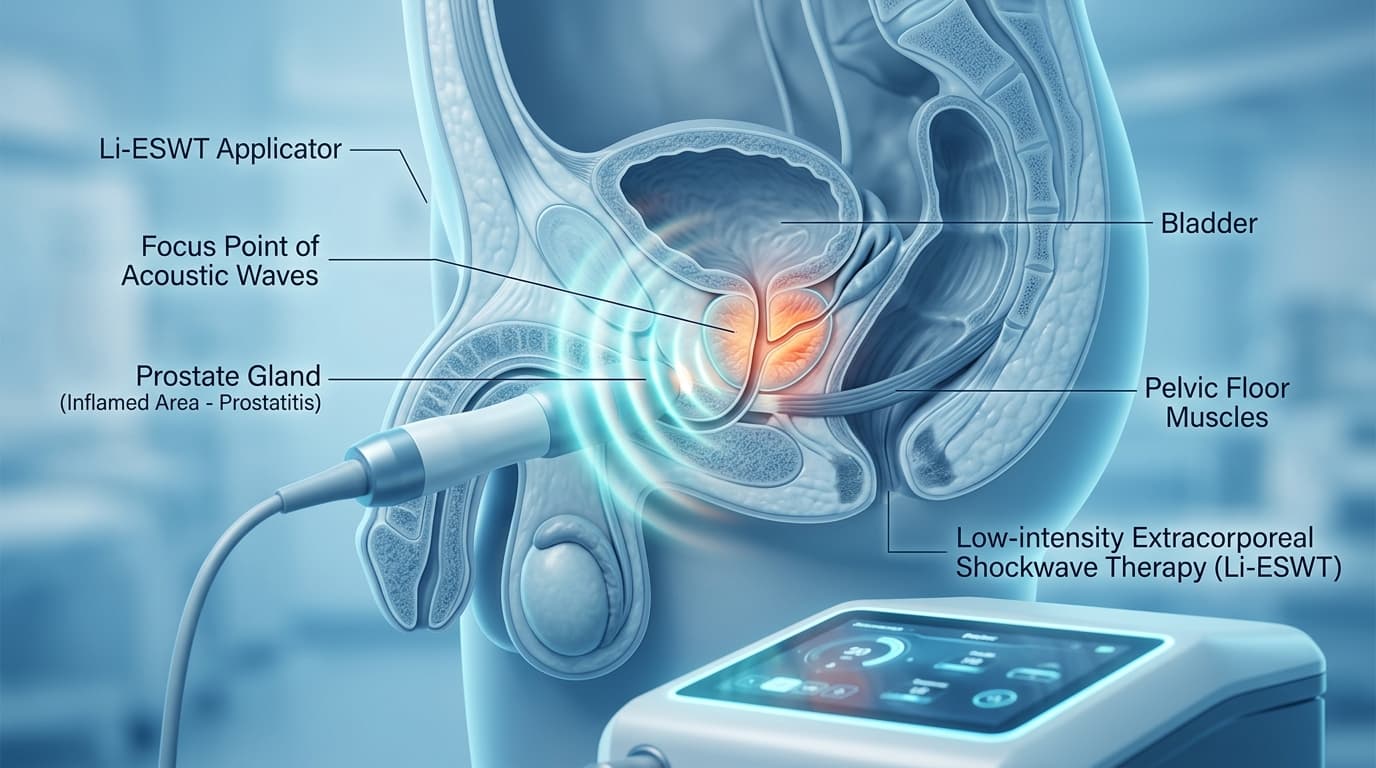
What is Focused Shockwave Therapy for Prostatitis?
Chronic Prostatitis/Chronic Pelvic Pain Syndrome (CPPS), also known as non-bacterial prostatitis (NIDDK Category III), is a highly frustrating and difficult condition to treat. Patients often experience pelvic, perineal, or lower abdominal pain along with urinary irritation. Standard treatments like long-term antibiotics or anti-inflammatories frequently offer only temporary relief before symptoms flare up again under stress or fatigue [1].
**Focused Shockwave Therapy** or Low-Intensity Extracorporeal Shockwave Therapy (Li-ESWT) is a revolutionary, non-invasive treatment. By delivering highly focused acoustic pressure waves through the perineal skin directly to the prostate gland, it triggers mechanotransduction—a cellular process that stimulates blood vessel regeneration, shuts down localized inflammatory pathways, desensitizes pain receptors, and breaks pelvic floor muscle spasms [2].
4 Biological Mechanisms of Focused Shockwave Action
The acoustic energy of Focused Shockwave targets chronic pelvic pain through four synergistic pathways [3]:
Biological Details of Focused Shockwave Action
1. Neoangiogenesis (New Blood Vessel Creation)
The acoustic pulses trigger microvascular growth factors like eNOS and VEGF. This stimulates the growth of new capillary networks, drastically improving blood flow, oxygenation, and nutrient delivery to the chronically inflamed prostate and pelvic floor [4].
2. Anti-inflammatory Effect
Low-intensity shockwaves down-regulate inflammatory cytokines (such as interleukins and TNF-alpha), resolving localized tissue edema and restoring healthy metabolic cellular activity in the prostate gland [5].
3. Nociceptor Desensitization
Continuous low-energy shockwaves desensitize painful C-nerve fibers. They reduce the expression of Substance P, the neurotransmitter responsible for transmitting pain signals to the brain, providing rapid and sustained pain relief [6].
4. Hypertonicity Relief (Muscle Spasm Elimination)
Many CPPS symptoms stem from subconscious, chronic spasms of the pelvic floor muscles. Shockwave energy breaks these deep myofascial trigger points, relaxing the surrounding musculature and relieving rectal, penile, and tailbone pressure [7].
The Treatment Protocol
The procedure is convenient, fast, pain-free, and performed on an outpatient basis [8]:
1. Position & Gel Application
The patient rests comfortably on their back. Ultrasound gel is applied to the perineum to act as a medium for the acoustic waves.
2. Acoustic Wave Delivery
The urologist applies the focused shockwave applicator to the perineal area, delivering approximately 3,000 to 4,000 pulses to targeted zones of the prostate.
3. Treatment Schedule
A standard protocol consists of one weekly 15-20 minute session for 4 to 6 weeks. There is no downtime or surgical incision; the patient can resume full activities immediately.
Pre & Post Treatment Guidelines
Tips to maximize the regenerative response of your cells [9]:
1. Before the Procedure
No fasting is required. If possible, avoid taking anti-inflammatory medications (NSAIDs) for 24 hours prior, as a controlled biological response is needed to stimulate tissue repair.
2. Post-Procedure Care
Stay well-hydrated. Avoid sitting on hard chairs or cycling for 24-48 hours to minimize nerve friction on the treated area.
3. Expecting Results
Most patients notice a significant decrease in pelvic pressure and pain after 2 to 3 sessions, with continuous improvement continuing after completion of the course.
Side-by-Side Comparison: Focused Shockwave vs. Standard Medications
Comparing focused acoustic waves to long-term oral drug therapy for chronic pelvic pain (CPPS) [10]:
Efficacy and Limitations of Focused Shockwave for CPPS
⊕ ข้อดี (Pros)
- ✓Provides 70-80% reduction in deep perineal, penile, and rectal pain.
- ✓Improves local blood flow, which can also enhance erectile function affected by pelvic pain.
- ✓Reduces or eliminates the need for long-term oral antibiotic use.
- ✓An outpatient, drug-free procedure that requires no anesthesia or recovery time.
- ✓Relaxes tight pelvic floor muscles, facilitating a stronger, easier urinary flow.
⊖ ข้อจำกัด (Cons)
- ✗Not indicated for acute bacterial prostatitis, which requires urgent systemic antibiotics.
- ✗Requires multiple weekly sessions to achieve optimal tissue regeneration and pain relief.
- ✗Initial per-session cost may be higher than starting basic pain medications.
Who is a Candidate for Focused Shockwave?
Recommended for patients meeting these diagnostic profiles [11]:
- ▹Patients diagnosed with Chronic Pelvic Pain Syndrome (CPPS): Experiencing persistent pelvic or perineal discomfort for over 3 months.
- ▹Patients who have failed medical therapy: Experiencing no relief from antibiotics, anti-inflammatories, or alpha-blockers.
- ▹Patients with painful ejaculation: Or those experiencing erectile dysfunction secondary to pelvic floor pain.
- ▹Patients seeking a drug-free option: To avoid the risks of long-term antibiotic resistance and gastric side effects.
Clinical Efficacy & Success Rates
Efficacy parameters established in international urological studies [12]:
Patient Satisfaction
Reported substantial relief in voiding ease and pelvic comfort post-therapy.
NIH-CPSI Score Reduction
Significant drops in standard chronic prostatitis pain indexes.
Severe Complication Rate
Completely safe procedure with no structural or long-term adverse effects reported.
Post-Treatment Follow-up
Monitoring recovery and maintaining long-term wellness [13]:
- •NIH-CPSI Index Evaluation: Re-assessing pain and quality of life scores at 1 and 3 months to monitor progress.
- •Maintenance Sessions: Patients with severe, long-standing symptoms may benefit from a booster session every 6-12 months.
- •Combined Pelvic Physical Therapy: Integrating muscle release techniques for patients with skeletal alignment issues.
How to Prevent Prostatitis Flare-ups
Healthy habits to keep the pelvic floor relaxed and the prostate healthy [14]:
- •Avoid Prolonged Sitting: Get up and stretch for 5 minutes every 45-60 minutes to relieve pressure on the perineum.
- •Stress Management: Stress causes involuntary pelvic floor contraction. Deep breathing exercises can help prevent spasms.
- •Maintain Regular Ejaculation: Ejaculating 1-2 times a week helps empty the prostate ducts and reduces localized pressure.
- •Proper Voiding Mechanics: Do not strain during urination; straining pushes urine back into the prostatic ducts, causing chemical irritation.
Related Topics
Academic References & Medical Literature
- Zimmermann R, et al. 'Extracorporeal Shock Wave Therapy for the Treatment of Chronic Pelvic Pain Syndrome.' European Urology, 2009; 56(3):418-424. doi:10.1016/j.eururo.2009.03.054.
- Al Edwan GM, et al. 'Low-Intensity Extracorporeal Shockwave Therapy in Chronic Prostatitis/Chronic Pelvic Pain Syndrome.' Journal of Urology, 2020; 204(3):484-490. doi:10.1097/JU.0000000000000984.
- Mottet N, et al. 'EAU Guidelines on Chronic Pelvic Pain.' European Association of Urology Guidelines, 2024.