NanoKnife (IRE - Irreversible Electroporation)

Medical Review & Verification: Dr. Niti Navanimitkul, M.D.
Board-Certified Urological Surgeon | Specialist in Minimally Invasive Prostate Treatments | M-Trust Urology Clinic
Last Reviewed: July 2026A revolutionary non-thermal focal ablation technology for localized prostate cancer that uses high-voltage electrical currents to destroy cancer cells while perfectly sparing nerves and blood vessels.
What is NanoKnife (IRE)?
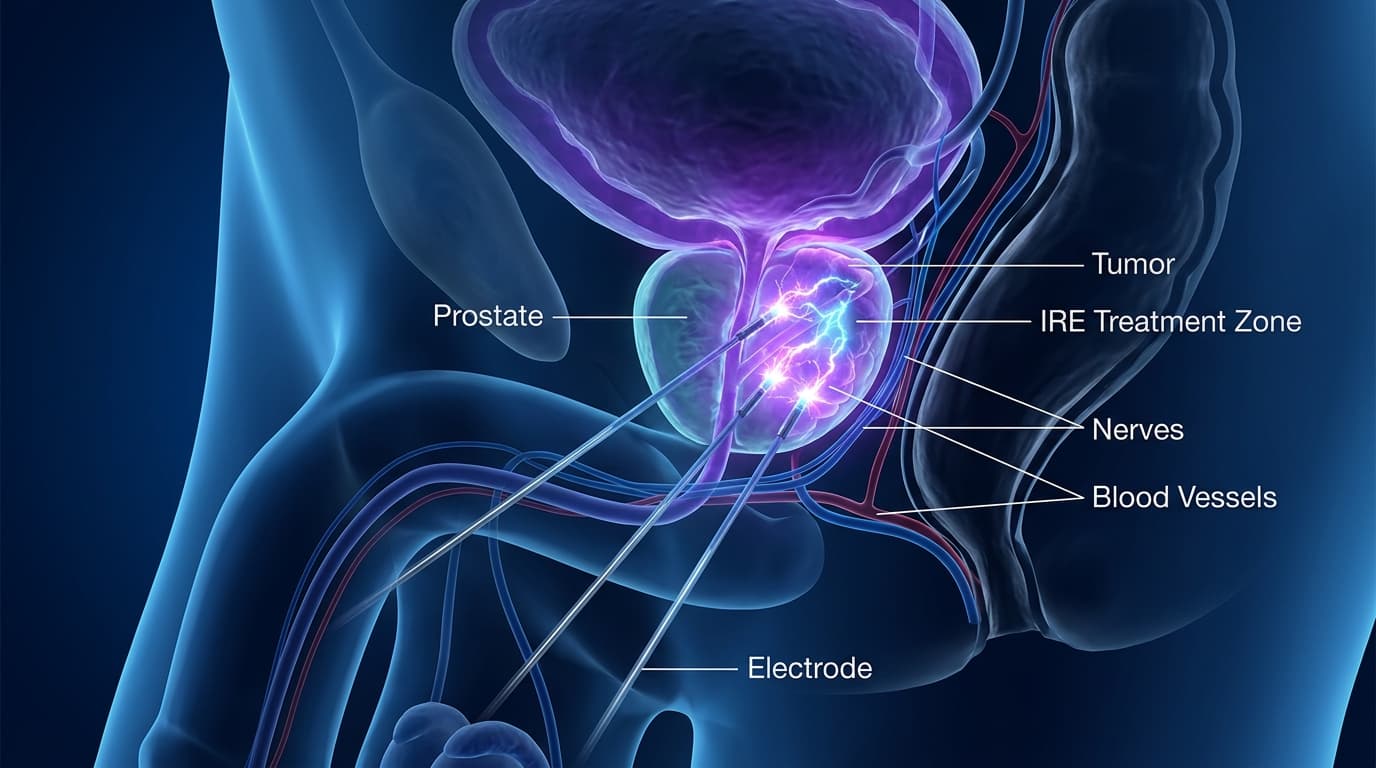
NanoKnife, or Irreversible Electroporation (IRE), is a cutting-edge, non-thermal focal ablation technology designed to treat localized prostate cancer. By placing ultra-fine electrode probes around the tumor under precise imaging guidance, the system delivers short bursts of high-voltage electrical current. This energy creates permanent nanoscale pores in the cancer cell membranes, causing the cells to undergo apoptosis (natural cell death) [1].
Unlike thermal ablation methods (such as HIFU or Cryotherapy) which burn or freeze tissues, NanoKnife is completely non-thermal. It targets only cellular structures while preserving the extracellular collagen scaffolding, blood vessels, the urethra, the rectal wall, and the crucial neurovascular bundles that control erections. This dramatically lowers the risk of erectile dysfunction (ED) and urinary leakage [2].
The Non-Thermal Advantage
Because NanoKnife does not generate high heat or freezing cold, it is completely free from the 'thermal sink effect'—where blood flow in nearby large vessels cools down thermal energy, leaving cancer cells untreated. This allows for highly precise, millimeter-level treatment borders even when the tumor is located adjacent to major blood vessels, the urinary sphincter, or erectile nerves, ensuring maximum safety and quality of life preservation [3].
How NanoKnife Works
The procedure is performed under spinal or general anesthesia with complete muscle relaxation to prevent muscle contraction during pulse delivery [4]:
1. Precise Probe Guidance
Fine electrode needles are placed through the perineum and positioned around the tumor target using mpMRI-Ultrasound fusion guidance.
2. Electrical Pulse Delivery
High-voltage electrical current is pulsed between the probes, piercing the cancer cell membranes with permanent micro-holes.
3. Natural Clearance
The treated cells die off naturally over the coming weeks and are cleared away by the body's immune system, leaving the healthy cellular matrix intact.
Pre-treatment Diagnostic Workup
A comprehensive clinical assessment is mandatory to determine candidates suitability [5]:
1. Multiparametric MRI (mpMRI)
Essential to precisely locate the index tumor lesion and measure its borders relative to vital pelvic structures.
2. MRI-Ultrasound Fusion Biopsy
Taking targeted tissue samples to verify the tumor grade (Gleason score) and ensure no high-grade disease is present in other areas.
3. Cancer Staging Validation
Ensuring the cancer is confined to the prostate (T1c - T2b) with no evidence of extra-capsular extension or bone metastases.
NanoKnife vs. Alternative Treatment Options
An academic side-by-side comparison of local therapies and surgery [6]:
Clinical Advantages and Limitations of NanoKnife (IRE)
⊕ ข้อดี (Pros)
- ✓Non-thermal energy preserves vital anatomy: blood vessels, nerves, rectum, and urethra.
- ✓High rate of erectile function and urinary continence preservation.
- ✓No thermal sink effect allows complete ablation near large blood vessels.
- ✓Promotes rapid tissue clearance and healing by triggering natural cell apoptosis.
- ✓Minimally invasive, leaving only tiny needle punctures in the perineum.
⊖ ข้อจำกัด (Cons)
- ✗Requires general anesthesia with deep muscle relaxation to prevent electrical muscle twitching.
- ✗Temporary urinary catheterization (3-5 days) is required due to transient tissue swelling.
- ✗Not suitable for advanced, extracapsular, or metastatic prostate cancer.
Who is a Candidate for NanoKnife (IRE)?
Strict patient selection criteria are applied to ensure optimal cancer control [7]:
- ▹Localized Prostate Cancer: Clinically staged as T1c to T2b (cancer entirely within the prostate).
- ▹Low-to-Intermediate Risk: Gleason Score of 6 or 7 (Grade Group 1 or 2).
- ▹PSA Level Below 15 ng/mL: With a tumor visible and targetable on mpMRI.
- ▹Tumor near vital structures: Excellent option for lesions close to the urethra or rectum where heat/cold therapies are risky.
- ▹Quality of Life Focus: Highly motivated patients wishing to avoid sexual dysfunction and urinary leakage.
Clinical Outcomes & Statistical Efficacy
Statistical data verified from international 3-to-5 year clinical trials [8]:
Potency Preservation
Most patients retain their erectile function and sexual activity levels after recovery.
Urinary Continence
Urinary control is fully preserved with virtually zero long-term leakage.
5-Year Cancer Control
Provides high focal clearance rates, comparable to radical surgery for selected patients.
Post-operative Surveillance Calendar
Close follow-up is necessary to monitor for any cancer recurrence [9]:
- •Month 1: Follow-up visit to monitor post-catheter voiding patterns and check healing progress.
- •Months 3, 6, 9 & 12: PSA blood tests every 3 months in the first year to monitor the Nadir PSA level.
- •Months 6 - 12: Follow-up mpMRI scan to confirm complete ablation of the target lesion.
- •Month 12: Confirmatory targeted biopsy of the treated zone to confirm pathological clearance.
Recovery Guidelines & Post-operative Care
Adhering to these guidelines minimizes swelling and promotes smooth recovery [10]:
- •Catheter Management: A temporary urinary catheter is required for 3-5 days to prevent retention from prostate swelling.
- •Perineal Care: Keep the perineal needle puncture sites dry and clean to prevent infection.
- •Hydration: Drink 2 to 3 liters of water daily to flush out cellular debris and prevent urinary infections.
- •Avoid Pelvic Pressure: Avoid cycling, heavy lifting, or strenuous pelvic exercises for 2-3 weeks.
Related Topics
Academic References & Medical Literature
- Valerio M, et al. 'Irreversible Electroporation (NanoKnife) for Localized Prostate Cancer: 3-Year Follow-up.' BJU International, 2021; 128(S3):25-32. doi:10.1111/bju.15582.
- Guenther E, et al. 'Prospective Phase II Trial of Irreversible Electroporation for Localized Prostate Cancer.' Journal of Urology, 2019; 202(6):1159-1167. doi:10.1097/JU.0000000000000412.
- Scheltema MJ, et al. 'Focal Biopsy-Guided Irreversible Electroporation (IRE) for Prostate Cancer: 5-Year Clinical Outcomes.' World Journal of Urology, 2020; 38(6):1465-1472. doi:10.1007/s00345-019-02940-2.
- Coleman JA, et al. 'Focal Therapy for Prostate Cancer: AUA/SUO Guideline.' Journal of Urology, 2023.