SBRT (Stereotactic Body Radiotherapy) for Prostate Cancer

Medical Review & Verification: Dr. Niti Navanimitkul, M.D.
Board-Certified Urological Surgeon | Prostate Oncology & Minimally Invasive Specialist | M-Trust Urology Clinic
Last Reviewed: July 2026An advanced, ultra-precise, non-surgical external radiation therapy (such as CyberKnife) completed in just 5 sessions with sub-millimeter tracking accuracy.
What is SBRT?
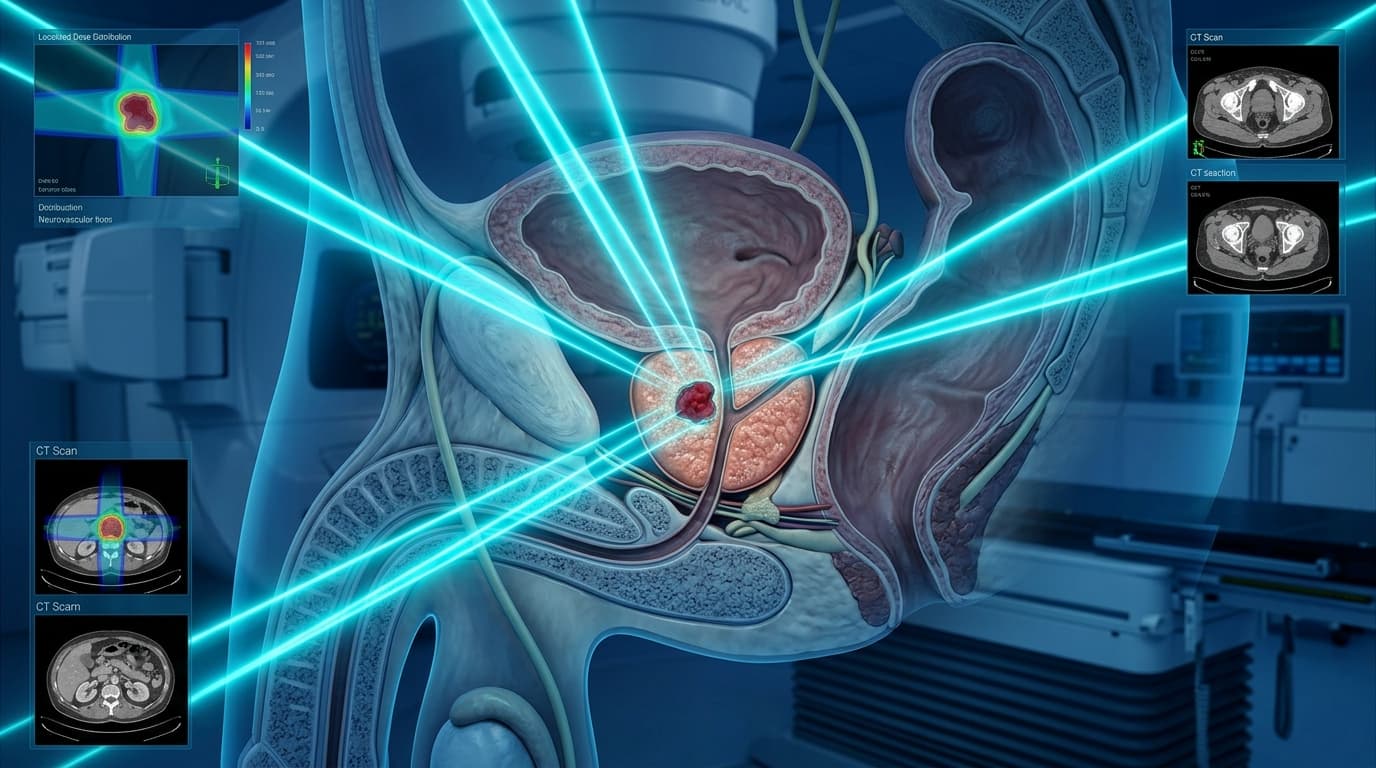
Stereotactic Body Radiotherapy (SBRT) is an advanced form of external beam radiation therapy that delivers highly concentrated, therapeutic doses of radiation to the prostate with extreme precision. Because it can deliver larger doses per treatment (hypofractionation) safely, SBRT shortens the standard radiation timeline from 40 daily sessions over 8 weeks to just 5 sessions completed in 1 to 2 weeks [1].
Modern SBRT (delivered via CyberKnife or advanced LINAC systems) utilizes a real-time motion tracking system. By implanting tiny gold fiducial markers into the prostate before treatment, the system tracks the prostate's position continuously throughout each session, accounting for movements caused by breathing or bowel gas. This allows for narrow 1-2mm treatment margins, shielding adjacent tissues like the bladder and rectum from unnecessary radiation [2].
Precision and Safety Profile
By maintaining sub-millimeter accuracy, SBRT drastically reduces radiation exposure to the rectum and bladder wall compared to older techniques. The risk of long-term radiation-induced side effects, such as rectal bleeding (radiation proctitis) or severe bladder irritation, is extremely low, occurring in less than 1.5% of treated cases [3].
How SBRT Works
The treatment is completely non-invasive and performed on an outpatient basis [4]:
1. Fiducial Marker Placement
A few tiny gold seeds are placed in the prostate under local anesthesia to act as continuous reference coordinates for the tracking software.
2. Treatment Simulation
High-resolution CT and MRI scans are mapped together to build a customized 3D computer plan of the prostate and surrounding organs.
3. Precision Beam Delivery
The robotic system delivers high-dose radiation beams from hundreds of angles. The beams dynamically adjust in real time to match any prostate movement.
Pre-treatment Clinical Workup
A complete diagnostic evaluation is performed to verify that SBRT is the optimal pathway [5]:
1. Histological Confirmation
Reviewing biopsy results, Gleason scores, and PSA levels to confirm localized low-to-intermediate risk disease.
2. Pelvic Anatomy Scan
Measuring prostate volume and pelvic anatomy to verify candidate eligibility and locate marker coordinates.
3. Rectal Hydrogel Spacer (Optional)
Injecting a temporary spacer gel (e.g. SpaceOAR) to create a protective gap between the prostate and rectum before radiation begins.
SBRT vs. Alternative BPH & Prostate Cancer Options
A comparison of SBRT, conventional radiation, and radical prostatectomy [6]:
Clinical Advantages and Limitations of SBRT
⊕ ข้อดี (Pros)
- ✓Highly convenient: completed in only 5 sessions over 1-2 weeks.
- ✓Completely non-invasive: no surgical incisions, no general anesthesia, and no hospital stays.
- ✓Real-time tracking software protects adjacent rectum and bladder tissue.
- ✓Provides excellent long-term cancer control equivalent to surgery.
- ✓Almost zero risk of post-treatment urinary incontinence.
⊖ ข้อจำกัด (Cons)
- ✗Erectile dysfunction (ED) may develop gradually over 2-5 years post-radiation.
- ✗Transient urinary frequency or mild bowel urgency may occur for 2-4 weeks after treatment.
- ✗No surgical tissue specimen is retrieved for post-treatment pathological staging.
Who is a Candidate for SBRT?
Clinical guidelines identify the following patient profiles as ideal candidates [7]:
- ▹Localized low-to-intermediate risk disease: Cancer confined entirely to the prostate capsule.
- ▹Patients seeking a non-surgical option: Elderly patients or individuals with cardiovascular risks that make surgery unsafe.
- ▹Active, busy individuals: Patients who cannot accommodate 2 months of daily hospital visits for conventional radiation.
- ▹Moderate prostate size: Prostates under 80-100 grams are ideal to minimize the radiation field area.
Clinical Outcomes & Efficacy Rates
Evidence-based statistics from multi-center SBRT consortium trials [8]:
5-Year bPFS Control Rate
High long-term biochemical cure rates in low-to-intermediate risk patients.
Potency & Continence
Urinary sphincter function remains untouched, preserving normal control.
Severe Rectal Toxicity
Real-time tracking keeps rectal side effects to an absolute minimum.
Post-treatment Surveillance Calendar
Systematic monitoring is required to verify the decline of PSA levels [9]:
- •Weeks 2 & 4: Follow-up check to monitor and manage any temporary bladder or bowel irritation.
- •Months 3, 6, 9 & 12: PSA tests every 3 months. PSA declines slowly over 1-3 years before reaching its nadir.
- •Year 2 & Beyond: PSA blood tests every 6 months and annual clinical check-ups.
Recovery Guidelines & Post-SBRT Care
Simple steps to support bladder and bowel comfort during the healing phase [10]:
- •Manage Bladder Irritation: Temporary urinary frequency is common; medications are provided to relax the bladder.
- •Maintain Clean Hydration: Drink 2 liters of water daily, avoiding alcohol, caffeine, or spicy foods that irritate the bladder.
- •Avoid Constipation: Eat fiber-rich foods and stay hydrated to prevent straining during bowel movements.
- •Semen Discoloration: Semen volume may decrease, and discoloration (brownish tint) is normal during the first few weeks.
Related Topics
Academic References & Medical Literature
- Brand DH, et al. 'Intensity-Modulated Fractionated Radiotherapy vs Stereotactic Body Radiotherapy for Prostate Cancer (PACE-B): 2-Year Toxicity and Efficacy Results.' Lancet Oncology, 2019; 20(11):1548-1559. doi:10.1016/S1470-2045(19)30569-8.
- Jackson WC, et al. 'Stereotactic Body Radiotherapy for Localized Prostate Cancer: A Systematic Review and Meta-Analysis.' JAMA Oncology, 2019; 5(8):1128-1136. doi:10.1001/jamaoncol.2019.0149.
- King CR, et al. 'Stereotactic Body Radiotherapy for Localized Prostate Cancer: Pooled Analysis from a Multi-Institutional Consortium.' Radiotherapy and Oncology, 2013; 109(2):217-221. doi:10.1016/j.radonc.2013.08.030.
- National Comprehensive Cancer Network (NCCN). 'NCCN Clinical Practice Guidelines in Oncology: Prostate Cancer.' Version 2.2024. 2024.