UroLift System for BPH

Medical Review & Verification: Dr. Niti Navanimitkul, M.D.
Board-Certified Urological Surgeon | Advanced Prostate Diagnostics Specialist | M-Trust Urology Clinic
Last Reviewed: July 2026An innovative approach to lift and hold enlarged prostate tissue out of the way. Instant relief, no hospital stay, and complete preservation of sexual function.
What is the UroLift System?
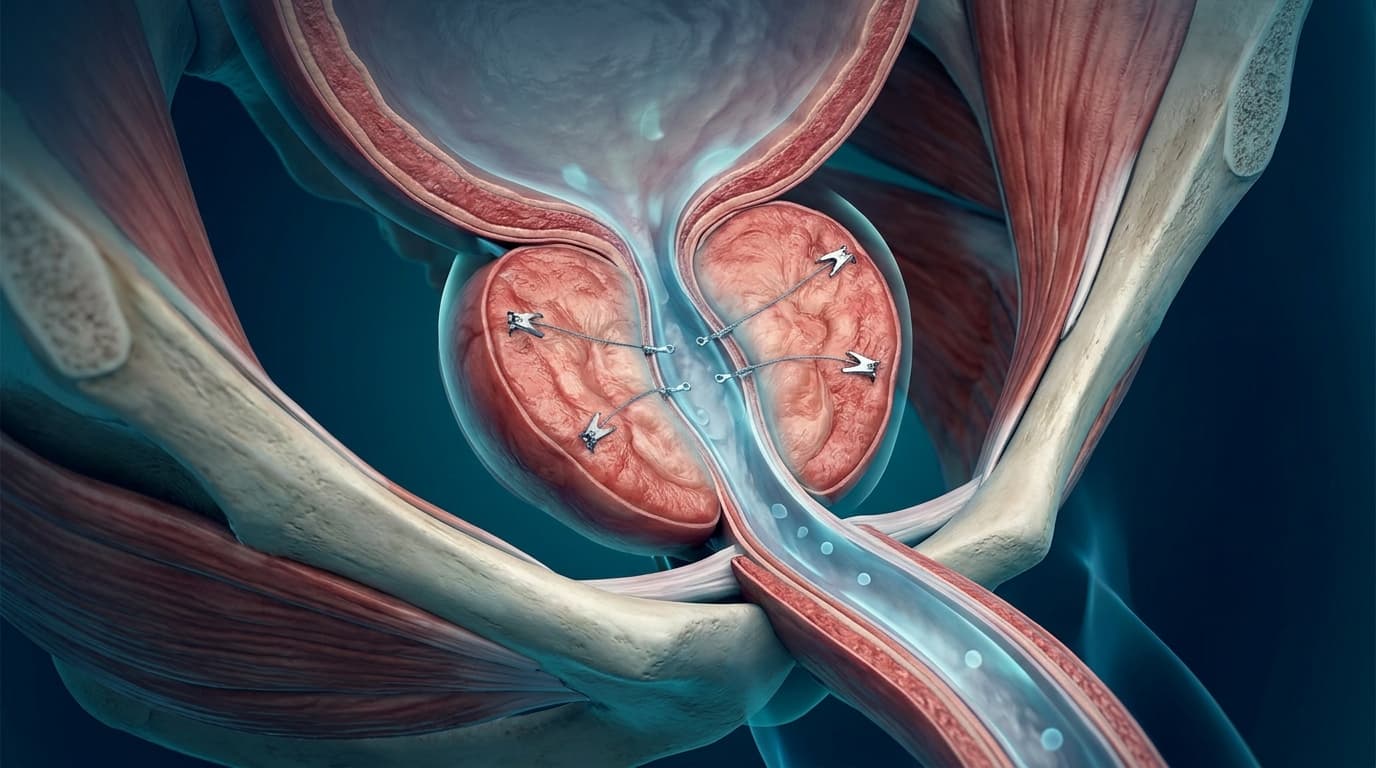
The UroLift System is a proven, minimally invasive technology FDA-cleared in 2013 for the treatment of Benign Prostatic Hyperplasia (BPH). It uses a purely mechanical approach to lift and hold the enlarged prostate tissue out of the way, rather than cutting, heating, or removing tissue.
This revolutionary approach is much like tying back window curtains to let light in. By avoiding the destruction of prostate tissue, UroLift eliminates the risk of nerve damage, making it the only BPH treatment that boasts zero incidence of new, sustained erectile or ejaculatory dysfunction.
Deep Dive: Mechanism of Action
The UroLift System provides a mechanical, anatomical solution to urinary obstruction:
1. Transurethral Access
A urologist inserts a standard cystoscope and the UroLift delivery device through the urethra to access the obstructive prostate lobes.
2. Tissue Compression
The device is used to compress the obstructing prostatic lobe, creating a widened urethral channel.
3. Implant Delivery
Small, permanent UroLift implants (made of nitinol and stainless steel) are deployed to securely hold the tissue in the retracted position.
4. Immediate Channel Opening
Typically, 4 to 6 implants are placed. The urethral channel is immediately opened, allowing urine to flow freely without waiting for tissue absorption or healing.
Pros and Cons of UroLift
⊕ ข้อดี (Pros)
- ✓Immediate, visible relief of urinary obstruction right after the procedure.
- ✓Most patients do not require a postoperative urinary catheter.
- ✓No cutting, heating, or removal of tissue, leading to minimal bleeding.
- ✓100% preservation of erectile and ejaculatory function (no retrograde ejaculation).
- ✓Fast procedure (typically 15-30 minutes) performed under local anesthesia.
- ✓Extremely rapid return to normal daily activities (usually within days).
⊖ ข้อจำกัด (Cons)
- ✗Temporary side effects such as pelvic ache, dysuria, and urgency for 1-2 weeks.
- ✗Not indicated for severely enlarged prostates (typically limited to <100cc).
- ✗May not be suitable for patients with a highly obstructive median lobe.
- ✗Potential need for retreatment in the long term if the prostate continues to grow.
Who is a Candidate for UroLift?
According to clinical guidelines and the FDA, UroLift is an excellent option for:
- ▹Men aged 50 and older experiencing LUTS secondary to BPH.
- ▹Patients with a prostate volume of up to 100 cm³.
- ▹Men who desire immediate symptom relief and wish to avoid a catheter.
- ▹Patients whose primary priority is the preservation of sexual function.
- ▹Men seeking an alternative to the daily side effects of BPH medications.
- ▹Those who prefer a minimally invasive outpatient procedure over traditional surgery (like TURP).
Comparison: UroLift vs. Traditional TURP vs. BPH Medications
An academic comparison of efficacy, safety profiles, and impact on long-term quality of life.
Clinical Outcomes & Durability
Based on the landmark L.I.F.T. randomized controlled trial published in leading urology journals:
De Novo Ejaculatory Dysfunction
UroLift is unique in demonstrating a 0% rate of new-onset retrograde ejaculation.
Increase in Urine Flow
Peak urinary flow rate (Qmax) shows rapid and significant improvement.
Years of Sustained Relief
Symptom improvement is highly durable through 5 years of clinical follow-up.
Recovery & Temporary Side Effects
UroLift offers one of the fastest recovery profiles among BPH interventions:
- •Catheter-Free: Approximately 80% of patients do not require a urinary catheter upon discharge.
- •Mild Discomfort: Patients may experience mild pelvic discomfort, burning during urination, or an increased urge to urinate for 1-2 weeks.
- •Hematuria: Light blood in the urine is normal and resolves quickly within a few days.
- •Downtime: Most men can return to their normal routines, including work, within 2 to 3 days.
Related Topics
Clinical References
- Roehrborn CG, et al. 'Five year results of the prospective randomized controlled prostatic urethral L.I.F.T. study.' Canadian Journal of Urology, 2017.
- FDA Clearance for UroLift System (DEN130006 & K193269).
- Clinical guidelines by the American Urological Association (AUA) on the Surgical Management of BPH.